
Blog Post #6 – Working in AUTOMATA: The roles of the Computational Archaeology Laboratory of the Hebrew University of Jerusalem (HUJ)
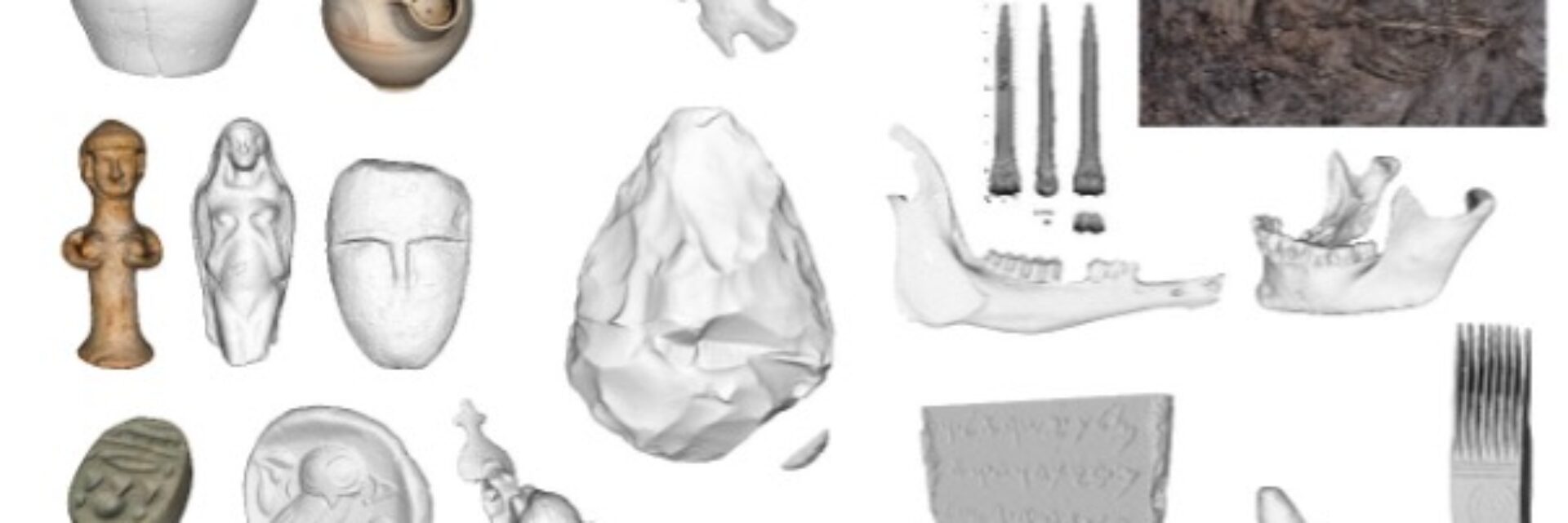
Concentrating on 3D digital models of archaeological artefacts we harness and develop algorithms and computational procedures to analyze the geometry and morphology of archaeological finds, in ways that are otherwise impossible. The data and insights deriving from such analyses lead the way to discussing technological, economic, social, or cognitive issues and assist in answering broad fundamental archaeological questions.
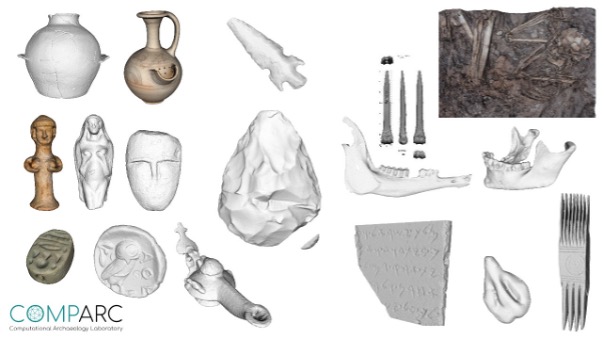
1. Various Archaeological finds 3D modeled at the Computational Archaeology Lab. (displayed in CompArchView, our in-house 3D visualization software)
How to make a 3D model?
3D modelling stands at the heart of the AUTOMATA project and is the first step in the project’s data collection procedure. 3D data, the building blocks of 3D digital models, may be collected in various ways, using different technologies. One of the first decisions the AUTOMATA team faced was – how to collect the 3D data for the construction of 3D models? What technology should be used and in what way?
The considerations were manifold: the process should be quick and the devices light and affordable; the artefact size range is small, and the accuracy must be high; the resolution needs to balance the ability to capture minute intricate geometry (heavy files) with limited archiving space and analysis needs (lightweight files).
Three optional technologies were considered – the inbuilt iPhone LiDAR system, Structured Light scanning and Photogrammetry. The iPhone LiDAR was considered for its affordability yet suffers from low resolution, inadequate for small objects. Structured Light excels in accuracy, yet devices tend to be expensive. Photogrammetry offers the best, true to life, appearance yet struggles with accurate capture and produces excessively heavy models.
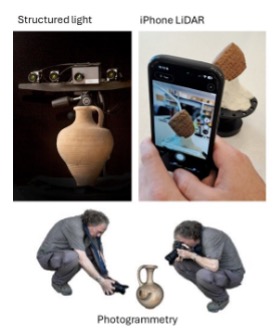
2. Various ways to collect 3D data
What is a good 3D model?
The collected 3D data is used to create a digital 3D model. In a very simplified way, a model is based on a point-cloud – a group of points (called vertices) defining the outer shape of an object, where the location of each point in space is identified by three coordinates (X,Y,Z). The point-cloud is turned into a mesh – each point is connected by lines (called edges) to the points around it, creating 2D surfaces between the points (called polygons or faces). The mesh is then turned into a model – each polygon is filled in by texture, color, sheen and other visual traits to create the appearance of the model (this is called rendering).
For the AUTOMATA project, we must ensure that all 3D models automatically produced along the process are ‘good’ – properly constructed and accurately recording the scanned artefact. What is a ‘good’ model? This is a philosophical question 😉 yet at its base the model needs to be ‘watertight’, properly aligned and fused, with clear boundaries and no outliers. What does all this mean? ‘Watertight’ means that there are no holes in the mesh, that all the points are connected, with full polygonal coverage of the surface of the object. ‘Aligned and fused’ means that there are no duplicated or overlapping points or faces, with no ‘outliers’ – no points that deviate from the actual boundaries of the object represented by the model.
Together with the AI team of the project, we conceptualized how AI and other algorithmic procedures could assist in this quality assurance task on-the-fly and devised a set of measurements and statistical tests for this purpose. These would be run on every produced 3D model to assure that it upholds at least these basic quality requirements before moving on to the next stage of analysis. Many more exciting challenges are still up ahead – for example, how can we assure that the model is not only technically and structurally sound, but that it accurately represents the real-life object? That the shape and appearance of the 3D model reflect what is really there? Interesting things to think about and there are more to come…
Future directions
Ultimately, we ask – what would users do with the archived data collected through the AUTOMATA project? What would the 3D models be used for? Beyond visualization, beyond the ability of a user to view and unaidedly examine 3D models, we plan to integrate computational tools in the database that would allow users to perform various geometric analyses on the 3D models of lithic and ceramic artefacts making up the assemblage.
Traditionally, ceramic types are identified by vessel profiles. The ceramic profile (a vertical cross-section of the vessel) tells the researcher if a vessel is open or closed, what are its size and proportions and how its outline curves. These characteristics of the profile help researchers identify differences and similarities between vessels and assign them to typological groups. For the AUTOMATA project, we will implement the basic functions of Pottery 3-D, an in-house developed software, for automatic extraction of vessel profiles, using algorithms based on ceramics’ inherent axial symmetry. Possible additional functions will include the ability to produce a ‘publication-ready’ profile illustration, perform various measurements and automatic typological clustering.
For the analysis of lithic artefacts, we plan to implement procedures from another in-house software – Artifact 3-D. Such functions will establish repeatable positioning of the 3D models based on the artefact’s individual inherent geometry, which will allow the execution of consistent automatic measurements, identification of the center of mass, asymmetry assessment, scar tracing and edge angle calculation.